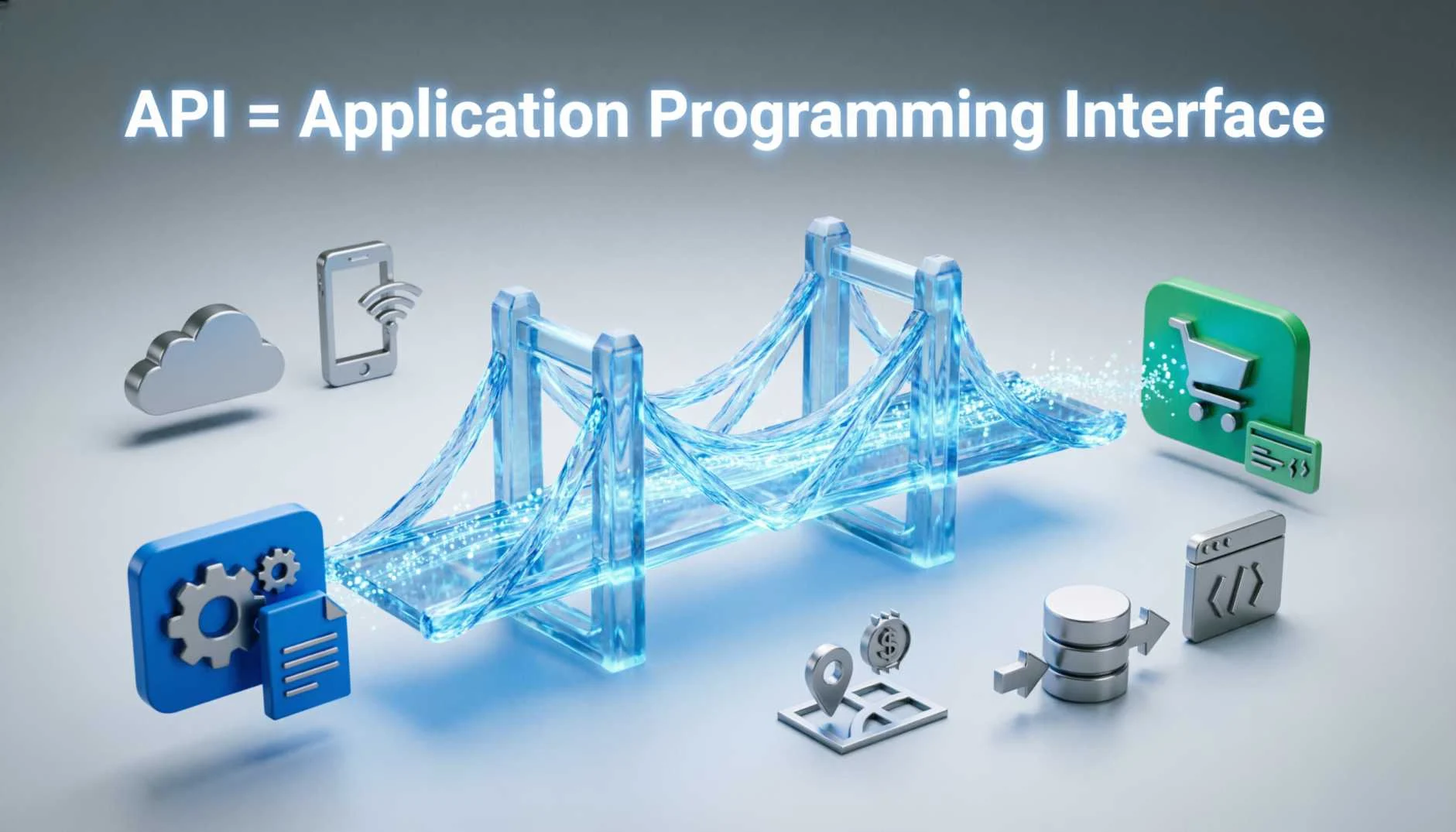
API stands for Application Programming Interface. It’s a set of rules that lets two software programs talk to each other: one program asks for something, the other sends back a response, without either one needing to know how the other works internally.
That one-line definition answers the search query, but it doesn’t explain why APIs matter, how they show up in daily life, or how the term is used differently across industries like oil and gas, pharma, and finance. This guide covers all of that, in plain language, with real examples.
Featured Snippet:
API stands for Application Programming Interface. It is a set of rules and protocols that allows one piece of software to request data or services from another. Think of it as a waiter in a restaurant: you (the app) tell the waiter (the API) what you want, the waiter takes that request to the kitchen (the server), and brings your order back. You never have to enter the kitchen or understand how the food is cooked; the API handles the communication for you.
What Is an API in Simple Terms?
In simple terms, an API is a messenger between two computer programs. It carries a request from one app to another and returns the answer.
For example, when a weather app on your phone shows today’s forecast, it isn’t measuring the weather itself. It sends a request through an API to a weather service’s server, which replies with the current temperature and conditions.
You don’t see the API. You only see the result of the forecast on your screen. That’s the whole point: APIs hide the complicated technical work and expose only what the other program needs.
What Is an Example of an API?
Everyday examples make APIs easier to picture:
- Logging in with Google or Facebook in a new app uses an API to verify your identity without storing your password.
- A travel booking site showing flight prices from multiple airlines uses each airline’s API to pull live prices.
- A food delivery app showing a live map of your driver uses a mapping API (like Google Maps) to plot the route.
- A payment button on an online store uses a payment API (like Stripe or PayPal) to process the transaction securely.
In each case, the app you’re using is talking to another company’s software behind the scenes, through an API.
What Are the Four Types of APIs?
APIs are commonly grouped by who can access them:
| Type | Who Can Use It | Example |
| Open (Public) API | Anyone, often with a free sign-up | Twitter/X API, OpenWeatherMap API |
| Partner API | Approved business partners only | An airline sharing flight data with travel agencies |
| Internal (Private) API | Only within one company | A company’s HR system talking to its payroll system |
| Composite API | Combines several API calls into one, for efficiency | An e-commerce checkout that pulls inventory, pricing, and shipping in a single request |
Separately, APIs are also grouped by architecture style: REST, SOAP, GraphQL, and WebSocket being the most common. Those describe how the API is built, while the four types above describe who is allowed to use it.
What Is an API for Idiots?
Nobody is an idiot for not knowing this. PI is genuinely one of the more confusing tech terms because you never interact with it directly. Here’s the simplest possible explanation:
Imagine a restaurant. You don’t walk into the kitchen and cook your own food. You tell a waiter what you want. The waiter is the go-between. An API is that waiter, but for software: it takes a request from one program, delivers it to another, and brings back the result.
That’s it. Everything else is detail on top of that basic idea.
Is ChatGPT an API?
No. ChatGPT is a product, a chat interface you type into. But ChatGPT is built on a large language model that OpenAI also makes available through an API, so developers can add similar chat capabilities into their own apps.
So the relationship is: the underlying model has an API, and ChatGPT is one specific application that uses that technology through a chat interface, not an API itself.
Why Is ChatGPT Called GPT?
GPT stands for Generative Pre-trained Transformer. Each word describes something about how the model works:
- Generative: it generates new text rather than just retrieving stored answers.
- Pre-trained: it was trained on a huge amount of text data before it’s ever used.
- Transformer: the underlying neural network architecture, first introduced by Google researchers in 2017, that lets the model weigh the importance of different words in a sentence.
“Chat” was added to the front because OpenAI built a conversational, chat-style product around the GPT model.
Does API Need Coding?
To build or connect to an API, yes, you typically need coding knowledge. Developers write code that sends requests to an API and handles the responses, usually in languages like Python, JavaScript, or Java.
However, you don’t need to code to benefit from APIs. Many no-code tools (like Zapier or Make) let non-programmers connect apps through APIs using a visual interface instead of writing code.
Is API Frontend or Backend?
An API sits between the frontend and the backend; it’s the connector, not strictly either one.
- The frontend is what a user sees and clicks on (the app or website interface).
- The backend is the server, database, and business logic behind the scenes.
- The API is the messenger that lets the frontend request data from the backend, and lets the backend send that data back in a structured format.
Some people still loosely call API work “backend development” because APIs are usually built and maintained by backend engineers.
Is API Easy to Learn?
Using a well-documented public API for a small project is fairly approachable for a beginner programmer, especially with tutorials and starter code. Designing and securing a production-grade API for a real business is a more advanced skill that takes practice.
A realistic learning path looks like this:
- Learn the basics of a programming language (Python or JavaScript are common starting points).
- Learn how web requests work (URLs, HTTP methods, status codes).
- Practice calling a free public API and reading its documentation.
- Try building a very small API of your own using a framework.
How Do I Create an API?
At a high level, creating an API involves these steps:
- Define what data or actions the API will expose (for example, letting other apps read a list of products).
- Choose an architecture style, most commonly REST.
- Build the API using a framework such as Express (JavaScript), Flask or FastAPI (Python), or Spring Boot (Java).
- Connect it to a database or data source so it has something to serve.
- Add authentication so only approved users or apps can access it.
- Write documentation so other developers know how to use it.
- Test it with tools like Postman before releasing it publicly.
Can I Create My Own API?
Yes. Anyone with basic programming knowledge can build a simple API, even for a personal or student project. You don’t need to work at a large company; free frameworks and free hosting options make it possible to build and publish a small API on your own.
Which API Is Mostly Used?
REST (Representational State Transfer) is the most widely used API style today. It’s popular because it’s simple, works over standard web protocols (HTTP), and returns data in an easy-to-read format called JSON.
GraphQL has grown quickly as an alternative for apps that need more flexible, precise data requests, but REST remains the default choice for most public and business APIs.
Which Type of API Is Best?
There’s no single “best” API type; the right choice depends on the project:
- REST best for most general-purpose, public-facing APIs. Simple and widely supported.
- GraphQL best when an app needs to request very specific combinations of data efficiently.
- SOAP best for enterprise systems (like banking or healthcare) that require strict security and formal contracts.
- WebSocket best for real-time features like live chat or live sports scores, where data needs to update instantly.
What Is REST and SOAP API?
REST and SOAP are two different sets of rules for building APIs:
- REST is a lightweight, flexible style that typically uses JSON and standard web addresses (URLs). It’s easier to read and faster to build, which is why it dominates modern web and mobile apps.
- SOAP (Simple Object Access Protocol) is an older, stricter, more formal protocol that uses XML and includes built-in rules for security and error handling. It’s still common in banking, healthcare, and other industries where strict standards and formal contracts between systems matter.
In short: REST favors simplicity and speed; SOAP favors strict structure and reliability guarantees.
Is HTTP a Type of API?
Not exactly. HTTP (Hypertext Transfer Protocol) is the communication protocol that most APIs are built on top of; it’s the set of rules for sending messages across the internet. An API is the specific set of endpoints and rules a particular service defines using HTTP (or another protocol).
Think of HTTP as the road, and the API as the specific set of directions and destinations available on that road.
Is Using an API Illegal?
No, using an API is not illegal on its own. Most public APIs are specifically designed and offered by companies for outside developers to use. However, you should always:
- Follow the API’s terms of service and rate limits.
- Get proper authentication credentials (API keys) if required.
- Avoid using an API to scrape or misuse data in ways the provider prohibits.
Violating a company’s API terms of service could lead to your access being revoked, or in serious cases, legal consequences, but the technology itself is completely legitimate and legal to use correctly.
Is API Free to Use?
It depends on the provider. Many APIs offer a free tier with limited requests per day or month, then charge based on usage once you exceed that limit. Others are entirely free (often government or open-data APIs), while some, especially enterprise or high-volume APIs, are paid from the start.
Always check the specific API’s pricing page, since this varies widely by company and service.
Is API Only for AI?
No. APIs existed long before modern AI and are used across almost every category of software: banking apps, weather services, maps, e-commerce, social media, and more. AI companies (like OpenAI or Anthropic) also offer APIs so developers can access their models, but that’s just one use case among thousands.
Is Python an API?
No. Python is a programming language. You can use Python to build an API, or to write code that calls an API, but Python itself is a tool for writing software t an API.
Is GitHub an API?
GitHub is primarily a platform for hosting and managing code, but it also offers a public API (the GitHub API) that lets developers programmatically access repositories, issues, pull requests, and more. So GitHub itself is a platform, and one of its many features is an API for developers.
Is Netflix an API?
No, Netflix is a streaming service, but Netflix does use APIs extensively behind the scenes; for example, to deliver video content to different devices (TVs, phones, game consoles) and to power personalized recommendations. Netflix also previously offered a public API for developers, though broad public access was scaled back over the years as Netflix focused its API work on internal and partner use.
What Kind of AI Is Netflix Using?
Netflix uses machine learning and recommendation algorithms to personalize what you see, including predicting which shows you’re likely to enjoy, customizing thumbnail images, and ranking search results. These systems analyze viewing patterns across its subscriber base rather than relying on a single public AI model.
What Does API Stand For in Different Industries?
The letters “API” stand for Application Programming Interface in technology contexts, but the same three-letter abbreviation means something completely different in a few other industries. Context matters.
What Does API Stand For in Oil and Gas?
In oil and gas, API stands for the American Petroleum Institute, a U.S. trade association that sets industry standards, including the widely used API gravity scale, which measures how light or heavy a crude oil is compared to water.
What Does API Stand For in Computer Science?
In computing, API stands for Application Programming Interface, the same definition covered throughout this article: a set of rules that lets software programs communicate with each other.
What Does API Stand For in Pharma?
In pharmaceuticals, API stands for Active Pharmaceutical Ingredient, the specific chemical compound in a drug that produces its intended therapeutic effect. A pain relief tablet, for instance, contains an API (like ibuprofen) combined with inactive ingredients that form the rest of the pill.
What Does API Stand For in AI?
In the context of artificial intelligence, API still stands for Application Programming Interface. AI companies expose their models through APIs so developers can send text, images, or other data to the model and receive a generated response back, without needing to run the AI model themselves.
What Does API Stand For in Finance?
In finance, API also stands for Application Programming Interface. Banks and financial platforms use APIs to let apps securely access account data, process payments, or pull real-time stock prices. This is often called “open banking” when banks share data through APIs with authorized third-party apps.
What Does API Stand For in Welding?
In welding and pipeline construction, API refers to standards published by the American Petroleum Institute, which also certifies welding procedures and pipeline materials used in the oil and gas industry, connecting back to the same organization mentioned above.
What Does “API” Mean on Asian Social Media or Slang Contexts?
Searches for “what does API stand for Asian” typically stem from confusion with a different, unrelated abbreviation, API, which stands for Asian American and Pacific Islander, a demographic term used in the U.S. This is not related to the technology term API at all; the similarity is just in the letters.
Related AI Questions People Also Ask
A few of the most common follow-up questions people search alongside “API” relate to AI more broadly rather than APIs specifically. Here are straightforward answers:
Will AI replace APIs? No. AI tools are actually increasing the need for APIs, since AI systems rely on APIs to access live data, tools, and other software. AI and APIs work together rather than replacing one another.
Which AI has the best API? This depends on the use case, pricing, and specific features needed, and rankings shift frequently as providers release new models. It’s worth comparing current documentation and benchmarks from providers directly rather than relying on a fixed answer.
Is there no AI without API? Not quite a I model can technically run without an API (for example, entirely on your own computer). But most people access AI tools through an API, because it’s the standard, secure way for one piece of software to use another company’s AI model over the internet.
Which three jobs will not survive AI? No credible source can name specific jobs guaranteed to disappear, since this depends on how quickly organizations adopt AI tools, not just what’s technically possible. Roles centered on highly repetitive, rules-based digital tasks face the most disruption, while jobs requiring hands-on physical work, complex judgment, or in-person trust tend to be more resistant to full automation, but predicting exact job losses isn’t something anyone can state as settled fact.
Who owns 51% of OpenAI? No single person or company owns 51% of OpenAI. As of 2026, OpenAI’s ownership is split between a controlling nonprofit foundation, Microsoft as its largest outside investor, and a mix of employees and other investors; no party holds a straight majority stake.
What shouldn’t you tell GPT? As a general safety practice, avoid sharing passwords, financial account numbers, medical records, or other sensitive personal information with any AI chatbot, since conversations may be stored or reviewed depending on the platform’s privacy policy.
Common Misunderstandings About APIs
- “API means a website.” Not quite; a website is what humans see; an API is what other software programs use to exchange data, often without any visible webpage at all.
- “Every app has a public API.” Many apps only use APIs internally and never expose one for outside developers.
- “APIs are only for big tech companies.” Small businesses, students, and hobbyists build and use APIs too.
Quick Summary
API stands for Application Programming Interface, a set of rules that lets software programs exchange requests and data without needing to understand each other’s internal code. REST is the most common API style today. APIs power almost every app you use daily, and while the term means something different in industries like oil and gas (American Petroleum Institute) or pharma (Active Pharmaceutical Ingredient), in technology it always refers to that same core idea: a structured way for programs to talk to each other.
FAQs
What does API stand for?
API stands for Application Programming Interface, a set of rules that lets two software applications communicate with each other.
What is the main purpose of an API?
An API’s main purpose is to let different software systems exchange data or trigger actions without needing to know how the other system is built internally.
Do I need to know an API is running when I use an app?
No. APIs work behind the scenes. You typically only notice the result, e a map loading or a payment going through, not the API call itself.
What’s the difference between an API and an SDK?
An API is a set of rules for communication between programs, while an SDK (Software Development Kit) is a fuller toolkit, often including samples, documentation, and other tools that help developers build for a specific platform.
Can APIs be hacked?
Like any internet-connected system, poorly secured APIs can be vulnerable to attacks such as unauthorized data access. This is why proper authentication, rate limiting, and encryption are essential parts of API security.
What does “calling an API” mean?
“Calling an API” means sending a request to it, for example, asking it for data or telling it to pact nd then receiving a response.
Why do companies charge for API access?
Running and maintaining an API costs money in server infrastructure and engineering time, so many companies charge based on usage once a free tier is exceeded, especially for high-volume or resource-intensive requests, such as AI model calls.
Conclusion
API stands for Application Programming Interface, a set of rules that allows different software programs to communicate and exchange data. You use APIs every day, often without realizing it, when checking the weather, making online payments, viewing maps, or signing into an app.
The simplest way to understand an API is to think of it as a messenger between two programs. It carries a request from one system to another and returns the requested information or action. REST is the most widely used API style, while GraphQL, SOAP, and WebSocket APIs serve different needs.
The meaning of API can also change depending on the industry. In technology, it means Application Programming Interface, while in oil and gas it can mean American Petroleum Institute, and in pharmaceuticals it means Active Pharmaceutical Ingredient.
Once you understand APIs as a way for software to communicate, many everyday technology concepts become much easier to understand.
In short: API stands for Application Programming Interface, and once you understand it as a messenger between two programs, nearly every confusing tech headline involving the word “API” starts to make sense.
Featured Image Prompt

I am JohnsonMili, a passionate Prayer Writer and Spiritual Content Researcher dedicated to illuminating the paths of those seeking solace and inspiration.Through my platform, PrayersInfo.com, I share powerful prayers and uplifting faith content designed to foster a deeper connection with God.My mission is to guide readers toward peace and hope, empowering them to navigate life’s challenges with spiritual resilience.Join me on this transformative journey as we explore the profound impact of prayer and faith together.