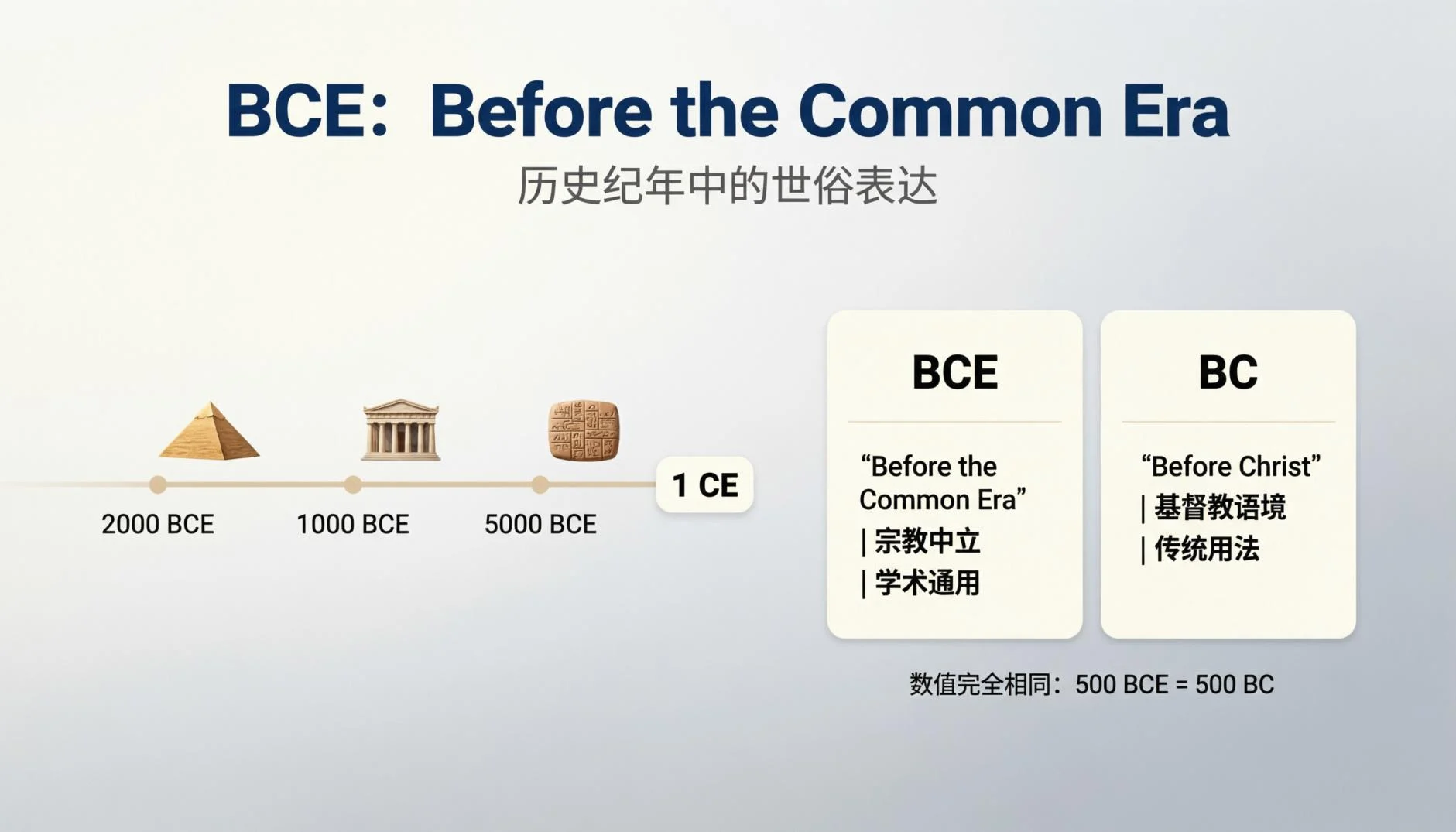
BCE stands for “Before the Common Era.” It is a way of labeling years that came before year 1 of the modern calendar, and it is used as a secular alternative to BC (“Before Christ”). Historians, scientists, and educators often prefer Before Common Era because it describes the same timeline without referring to a specific religion.
This guide breaks down exactly what BCE means, where it came from, how it compares to BC, CE, and AD, and how to use it correctly in writing. By the end, you’ll be able to read, write, and explain historical dates with confidence.
Quick Answer:
BCE means “Before the Common Era.” It labels any year before 1 CE, counting backward, and is numerically identical to BC. For example, 500 BCE is the same year as 500 BC. Writers use Before Common Era instead of BC to keep dates religiously neutral, since BC refers to “Before Christ.” BCE is common in academic, scientific, and international writing.
BCE Meaning Full Definition
Placed after a year number, such as 1200 BCE or 44 BCE,
the abbreviation BCE shows that an event happened before the start of the Common Era.
. The “Common Era” begins at year 1, the same starting point used by the traditional AD/BC system.
Here’s the key idea to remember:
- BCE years count backward. The further back in history, the higher the number. So 3000 Before Common Era is older than 1000 Before Common Era.
- There is no year 0. The calendar moves directly from 1 Before Common Era to 1 CE.
- BCE and BC represent identical years. Only the label changes, not the date itself.
Before Common Era is mainly used by historians, archaeologists, museums, textbooks, and researchers who want a term that doesn’t assume a particular religious viewpoint, while still using the same year numbers everyone already recognizes.
Origin of BCE
The idea of a “Common Era” is older than most people expect. Jewish scholars used similar non-religious terms for centuries when referencing the shared calendar used across different cultures. The abbreviations BCE and CE became widely adopted in academic and scientific writing from the late 20th century onward, as institutions looked for a dating system that could be used comfortably by people of all faiths and backgrounds.
Rather than replacing the calendar itself, Before Common Era simply relabels it. The numbering system based on the traditional starting point near the beginning of the Anno Domini calendar stayed the same.
How to Pronounce BCE
Before Common Era is pronounced by saying each letter individually: “B-C-E.” It is not read as a word. You would say a date like 500 Before Common Era as “five hundred B-C-E.” The same rule applies to CE, BC, and AD; all four are spoken letter by letter, never as blended words.
What Does BCE Mean in Urdu
In Urdu, BCE is generally explained as “قبل از مسیحی دور” or “مشترکہ دور سے پہلے,“ which translates to “before the common/Christian era.” Since Urdu writing on history often mirrors English academic conventions, many Urdu textbooks and articles simply keep the English abbreviation “Before Common Era” and explain it in Urdu text alongside it, especially in academic or archaeological contexts. The core meaning stays the same: a year before the start of the Common Era, equivalent to the BC system.
What Does BC Mean
BC stands for “Before Christ.” It refers to the years before the traditionally accepted birth year of Jesus Christ, which was used historically as the starting point of the Western calendar. Like BCE, BC counts backward; a higher number means an earlier point in history. For example, 776 BC refers to the time historians associate with the first recorded ancient Olympic Games, and it is a much older date than 100 BC.
BC and BCE refer to the same years. The only difference is that BC has a direct religious reference in its wording, while BCE avoids naming any specific faith.
What Does AD Mean
AD stands for “Anno Domini,” a Latin phrase meaning “in the year of the Lord.” It marks years counting forward from the same starting point used by BC, and it’s the traditional counterpart to CE. Unlike BC and BCE, AD is written before the year number in formal usage; for example, AD 800, though in everyday writing many people place it after the number as well, such as 800 AD.
AD years count upward as time moves forward, so AD 1500 comes after AD 800, and both are more recent than any BC or BCE date.
What Does BCE Mean in the Bible
Most traditional Bible translations use BC and AD rather than Before Common Era and CE, since these labels were the historical standard when those translations were produced. However, some modern academic Bible commentaries, historical study guides, and religious studies textbooks use Before Common Era and CE instead, particularly when discussing the Bible from a historical or archaeological standpoint rather than a purely religious one.
When Before Common Era appears in Bible-related scholarship, it means the same thing it means everywhere else: a year before 1 CE. For instance, a scholar might write that a particular Old Testament event is believed to have occurred around 1000 BCE, which is equivalent to saying 1000 BC.
What Does BCE Mean in English
In everyday English, BCE simply means “Before the Common Era.” It functions as a neutral, non-religious substitute for BC. English-language textbooks, encyclopedias, and news publications increasingly use Before Common Era and CE in historical writing, especially when covering topics that span multiple cultures and religions, such as world history, archaeology, or ancient civilizations outside the Western/Christian tradition.
What Does CE Mean
CE stands for “Common Era.” It labels years starting from year 1 and counting forward, exactly like AD. CE is the direct counterpart to Before Common Era; together, they cover the entire timeline without referencing any specific religion. For example, the year 2026 CE is the same as the year 2026 AD; only the label is different.
BCE and CE Meaning
Put simply, BCE and CE are a matched pair that split all of history into two blocks, exactly like BC and AD do:
| Term | Full Meaning | Direction | Example |
| BCE | Before the Common Era | Counts backward | 500 BCE |
| CE | Common Era | Counts forward | 500 CE |
BCE and CE are numerically identical to BC and AD. A historian using Before Common Era and one using BC/AD are describing the same timeline; they’ve simply chosen different labels for religious neutrality.
What Does Anno Domini Mean
Anno Domini is Latin for “in the year of the Lord.” It’s the full phrase behind the abbreviation AD, and it was historically used to mark years counting forward from the traditional starting point of the Western calendar. When someone asks what “Anno Domini” means, the short answer is that it’s simply the formal, spelled-out version of AD the counting-forward equivalent of BC, and the direct historical predecessor to the term CE.
BCE vs BC vs CE vs AD: Quick Comparison Table
| System | Stands For | Direction | Religious Reference? |
| BCE | Before the Common Era | Backward | No |
| BC | Before Christ | Backward | Yes |
| CE | Common Era | Forward | No |
| AD | Anno Domini (“year of the Lord”) | Forward | Yes |
Both pairs (BCE/CE and BC/AD) use the same numbering. Choosing one system over the other is a matter of style and audience, not a change in historical dates.
Common Mistakes When Using BCE
- Assuming BCE and BC are different years. They aren’t; 00 Before Common Era and 100 BC are the same year.
- Forgetting there’s no year zero. The calendar jumps from 1 Before Common Era straight to 1 CE.
- Mixing systems in one document. Style guides usually recommend picking either BCE/Before Common Era or BC/AD and staying consistent throughout a piece of writing.
- Placing AD incorrectly. Traditionally, AD goes before the year (AD 100), while BC, BCE, and CE go after the year (100 BC, 100 Before Common Era, 00 CE).
Quick Summary
BCE means “Before the Common Era” and is the neutral equivalent of BC. It counts years backward toward the more distant past, pairs with CE (Common Era) for years counting forward, and matches BC/AD numerically in every case. Many writers now prefer BCE and CE because they describe the same historical timeline without referencing a specific religion.
FAQs
Is BCE the same as BC?
Yes. BCE and BC refer to identical years o; the label differs. 44 Before Common Era and 44 BC both point to the same historical year.
Was Jesus born in BCE or CE?
Most historians place the birth of Jesus a few years before the start of the traditional calendar, meaning sources typically describe it using BC or Before Common Era, though the exact year is debated among historians and isn’t stated as an exact fact in this article.
Why do we say CE instead of AD?
Many writers use CE instead of AD because CE avoids the literal Latin meaning of AD (“year of the Lord”), making it a more neutral choice for readers of different religions or no religion.
Why is BC called BCE?
BC was relabeled as Before Common Era by scholars seeking a non-religious way to describe the same years, replacing “Before Christ” with “Before the Common Era” while keeping the same numbering.
Which is oldest, BC or AD?
This compares two different things. All BC (or BCE) years came before all AD (or CE) years. Within BC, a higher number is older; within AD, a higher number is more recent.
Are we living in AD or CE right now?
We are living in a year that can correctly be labeled either 2026 AD or 202CECEboth termsms describe the same current year.
Did a year zero exist in BC or AD?
No. The traditional calendar has no year zero. It moves directly from 1 BC to AD 1, which is why historians must calculate date spans carefully across that boundary.
How do you write a date using BCE?
Write the year number followed by Before Common Era
, such as “3000 BCE.” Unlike AD, BCE (like BC and CE) is placed after the number, not before it.
Do BCE and CE apply to all calendars worldwide?
No. BCE and CE are labels for the same calendar used in BC/AD systems. Many cultures use separate calendar systems entirely, such as the Islamic Hijri calendar or the Hebrew calendar, which count years differently.
Which is more commonly used today, BCE/CE or BC/AD?
Both are widely used. BC/AD remains common in everyday and religious contexts, while BCE/CE is increasingly common in academic, scientific, and international publications.
Conclusion
BCE, or Before the Common Era, is a simple way to label years before 1 CE without using religious terminology. It follows the same timeline as BC, so the only difference is the wording, not the dates themselves. For example, 500 BCE and 500 BC refer to the same year.
Today, BCE and CE are widely used in history, archaeology, education, science, and international publications because they provide a neutral dating system that works across cultures and religions. Whether you encounter BCE in a history book, museum, or research paper, understanding its meaning will help you read historical dates accurately and confidently.

I am JohnsonMili, a passionate Prayer Writer and Spiritual Content Researcher dedicated to illuminating the paths of those seeking solace and inspiration.Through my platform, PrayersInfo.com, I share powerful prayers and uplifting faith content designed to foster a deeper connection with God.My mission is to guide readers toward peace and hope, empowering them to navigate life’s challenges with spiritual resilience.Join me on this transformative journey as we explore the profound impact of prayer and faith together.