Integrity means doing the right thing consistently, even when it’s inconvenient or no one is watching.
It’s the alignment between what you believe, what you say, and what you actually do.
This article breaks down the full meaning of integrity, where the word comes from, how it shows up in real life, and how it differs from similar traits like honesty and morality.
Most people can define integrity in a single sentence, but few can explain why it’s so hard to practice consistently.
That gap between knowing and doing is exactly what this guide addresses, with grounded examples instead of vague inspirational talk.
Definition of Integrity
uprightness is the quality of being honest and having strong moral principles that stay consistent If or not anyone is observing you. It comes from a wholeness of character your actions, words, and values all point in the same direction.
A simple way to remember it: uprightness is who you are when there’s no audience to impress and nothing to gain from pretending.
The word carries two related meanings that often get blended together:
- Moral integrity consistently acting according to honest, ethical principles.
- Structural integrity a state of being whole, sound, and undivided (used for objects, systems, or data, as in “the uprightness of the bridge” or “data uprightness “).
Both meanings share the same root idea: nothing is broken, compromised, or split into contradictory pieces.
What Does Integrity Mean on Instagram?
On Instagram, honesty means being authentic, honest, and respectful in the way you create and share content. Instead of pretending to have a perfect life or copying other people’s work, users with honesty post truthfully, credit original creators, and avoid misleading their audience.
For influencers and businesses, integrity also means clearly disclosing sponsored posts, avoiding fake followers or engagement, and recommending products they genuinely believe in. Followers are more likely to trust creators who are transparent and consistent.
In simple terms, honesty on Instagram is about building trust rather than chasing attention.
What Does Integrity Mean in an Interview?
During a job interview, integrity means demonstrating that you are honest, dependable, and willing to make ethical decisions even when they are difficult. Employers ask about honesty because they want employees they can trust with responsibilities, confidential information, and teamwork.
Rather than simply saying you are honest, explain how your actions reflect integrity. Mention situations where you accepted responsibility, admitted a mistake, or chose the right action despite personal inconvenience.
Showing integrity in an interview often leaves a stronger impression than simply listing technical skills.
What Does Integrity Mean to You? Interview Question Example
One common interview question is, “What does honesty mean to you?”
A strong answer could be:
“Integrity means keeping my values consistent with my actions. It means being honest, taking responsibility for mistakes, and doing the right thing even when no one is watching.”
Whenever possible, support your answer with a real life example. Employers value candidates who can demonstrate integrity through experience rather than simply defining the word.
What Does Integrity Mean in Ethics?
In ethics, integrity refers to consistently following moral principles and making decisions based on fairness, honesty, and responsibility. Ethical honesty requires people to act according to their values, even when doing so is unpopular or personally difficult.
Professionals in medicine, law, education, and business are expected to maintain ethical integrity because their decisions directly affect other people’s lives and trust.
Ethics provides the principles, while honesty is the commitment to live by them consistently.
What Does Integrity Mean in an Object?
rectitude does not always refer to people. When talking about an object, honesty means that something remains complete, stable, and able to perform its intended function without damage.
For example:
- A bridge with structural probity can safely support traffic.
- A building with compromised honesty may become unsafe.
- Engineers regularly inspect the structural rectitude of roads, bridges, and buildings.
In technical fields, simply means that nothing essential has been weakened or broken.
Integrity Definition and Examples
Integrity is the quality of being honest, trustworthy, and committed to strong moral principles. A person with rectitude behaves consistently, If others are watching or not.
Here are common examples of honesty in everyday life:
- Returning a lost wallet with everything still inside.
- Admitting a mistake at work instead of hiding it.
- Refusing to cheat on an exam.
- Giving credit to someone else’s ideas.
- Keeping a promise even when it becomes inconvenient.
- Paying for an item after realizing it wasn’t charged.
- Speaking honestly even when the truth is difficult.
These examples show that probity is demonstrated through everyday actions rather than occasional grand gestures.
What Does Integrity Mean in School?
Integrity in school means acting honestly, responsibly, and respectfully in every aspect of student life. It includes completing your own assignments, avoiding plagiarism, following classroom rules, and treating classmates fairly.
Students who practice honesty develop trust with teachers, improve their personal character, and prepare themselves for future academic and professional success.
Examples include:
- Completing homework without copying.
- Citing research sources correctly.
- Admitting mistakes.
- Respecting school policies.
- Helping classmates without encouraging cheating.
Academic integrity is not only about grades it is about building lifelong character.
What Are the Five Values of Integrity?
rectitude is often built on five core values that guide ethical behavior:
Honesty
Always telling the truth and avoiding deception.
Accountability
Accepting responsibility for your actions and correcting mistakes.
Respect
Treating everyone fairly, regardless of their position or background.
Responsibility
Following through on commitments and doing your duties reliably.
Trustworthiness
Being dependable so others can confidently rely on your words and actions.
Together, these values create a strong foundation for personal and professional integrity.
Where the Word Integrity Comes From
Integrity comes from the Latin word integer, meaning “whole” or “untouched.” The same root gives us the math term “integer,” a whole number that isn’t broken into fractions.
This origin explains a lot about the modern meaning. A person with rectitude is, in a sense, a “whole number” not divided between a public self and a private self, not fractured between stated values and actual behavior.
The word entered English usage centuries ago, originally describing physical soundness (an intact structure) before expanding to describe moral wholeness in a person’s character.
How to Pronounce Integrity
rectitude is pronounced in TEG ri tee (IPA: /ɪnˈtɛɡrɪti/), with the stress on the second syllable.
A common mispronunciation stresses the first syllable (“IN teg ri tee”) or drops the middle sound entirely. Saying it slowly as four distinct parts in / teg / ri / ty helps lock in the correct rhythm.
The Core Elements of Integrity
Integrity isn’t a single behavior; it’s a pattern built from several habits working together.
| Element | What It Looks Like |
| Consistency | Same behavior in public and private |
| Honesty | Telling the truth even when a lie would be easier |
| Accountability | Owning mistakes instead of deflecting blame |
| Principled decision making | Choosing what’s right over what’s convenient |
| Reliability | Following through on commitments |
None of these traits alone equals integrity. A person can be honest but unreliable, or accountable but inconsistent. Integrity is the overlap of all of them, sustained over time rather than in a single good moment.
Integrity in Different Contexts
Personal Integrity
In everyday life, this quality means keeping promises to yourself and others, admitting mistakes without making excuses, and treating people with the same respect whether they can help you or not. It reflects honesty, consistency, and strong moral character in daily decisions.
Workplace and Professional Integrity
At work, ethical behaviour includes giving honest feedback, avoiding credit for someone else’s achievements, following company policies even when no one is watching, and reporting problems instead of hiding them. Employers value these traits because they build trust, accountability, and reliability under pressure.
Academic Integrity
In schools and universities, academic rectitude means completing your own work, citing sources correctly, and avoiding cheating on exams or assignments. Actions such as plagiarism, falsifying research, or unauthorized collaboration are considered serious violations of academic standards.
Data and Structural Integrity
In technical fields, the term refers to accuracy, reliability, and consistency. Data integrity ensures information remains complete and unaltered except through authorized changes, while structural rectitude describes a building, bridge, or other structure’s ability to safely support the loads it was designed to handle.
Scientific and Research Integrity
Researchers demonstrate ethical standards by reporting findings honestly, avoiding fabricated or manipulated data, following established research practices, and giving proper credit to contributors. These principles help maintain public trust and ensure scientific discoveries are reliable.
Real Life Examples of Integrity

Abstract definitions are easier to grasp with concrete situations.
- Daily conversation: Telling a friend you can’t make it to their event instead of making up a fake excuse.
- School: A student who finds an unattended answer key and doesn’t look at it, even knowing no one would find out.
- Workplace: An employee who notices a billing error in the company’s favor and reports it instead of staying quiet.
- Leadership: A manager who tells the team about a mistake she made, rather than letting a subordinate take the blame.
- Social media: Someone who publicly corrects their own earlier post after realizing they shared inaccurate information.
Each example shares the same thread: the honest choice wasn’t the easiest one, but it was made anyway.
Integrity vs. Similar Words
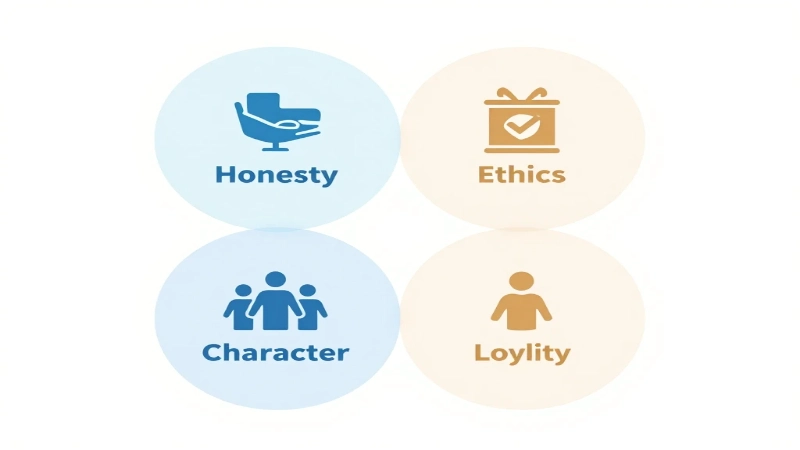
honor often gets used interchangeably with related words, but the differences matter.
| Term | Core Focus | Key Difference from Integrity |
| Honesty | Telling the truth | Honesty is one component of integrity, not the whole picture |
| Morality | Beliefs about right and wrong | Morality is the belief system; integrity is living by it consistently |
| Ethics | Rules or standards for a group/profession | Ethics are often external codes; integrity is internal consistency |
| Character | Overall personality and traits | Character is broader; integrity is one trait within it |
| Loyalty | Faithfulness to a person or group | Loyalty can conflict with integrity (e.g., covering for a friend’s wrongdoing) |
A useful distinction: you can be honest in a single moment, but honor requires that honesty to hold up over time and across situations, including ones nobody will ever find out about.
Common Misunderstandings About Integrity
Misunderstanding 1: Integrity means never making mistakes.
That’s a myth. This quality isn’t about being perfect; it’s about taking responsibility when things go wrong. Admitting mistakes, learning from them, and making them right shows far stronger character than trying to hide them.
Misunderstanding 2: It means always saying exactly what you think.
Being honest doesn’t require being harsh. You can speak the truth while choosing words with empathy, respect, and kindness. Tact and honesty often work best together.
Misunderstanding 3: It only matters in big, dramatic moments.
Strong character is usually shaped by small, everyday choices rather than rare heroic actions. Returning extra change, giving credit where it’s due, meeting commitments, and arriving on time are simple habits that build trust over time.
Misunderstanding 4: It’s the same as being “nice.”
Not always. Sometimes doing the right thing means delivering difficult news, setting healthy boundaries, or respectfully disagreeing with others. These actions may not always feel pleasant, but they reflect strong moral principles and consistency.
Signs Someone Lacks Integrity
Recognizing the absence of integrity is often easier than defining its presence. Common warning signs include:
- Behaving differently depending on who is watching.
- Making promises they don’t intend to keep.
- Blaming others instead of admitting personal mistakes.
- Bending rules whenever it’s convenient and unlikely to be noticed.
- Saying one thing to your face and another behind your back.
Seeing one of these occasionally doesn’t automatically mean someone lacks integrity everyone slips sometimes. A repeated pattern across situations is the real signal.
How to Build and Practice Integrity

Integrity develops through repeated small choices rather than a single decision to “have” it.
- Keep the small promises. Follow through on minor commitments (replying to a message, being on time) to strengthen the habit of reliability.
- Practice private accountability. Notice moments when no one would catch you cutting a corner, and choose not to anyway.
- Admit mistakes quickly. Own errors before someone else points them out.
- Align your words and actions. Before agreeing to something, ask If you’ll actually follow through.
- Choose consistency over convenience. When honesty is harder than a shortcut, that’s usually the moment integrity is being tested.
Expert tip: Integrity is easiest to lose gradually and hardest to rebuild quickly trust erodes with small inconsistencies long before it collapses in one big one.
FAQ
What does integrity mean in a person?
It means consistently acting with honesty, responsibility, and strong moral values. A person with this quality keeps promises, accepts responsibility for mistakes, and behaves ethically even when no one else is watching.
What are the five values of integrity?
The five commonly recognized values are honesty, accountability, respect, responsibility, and trustworthiness. Together, these principles help build strong character and lasting confidence in a person’s actions.
What is an example of integrity?
Returning a lost wallet with all its contents is a classic example. Other everyday examples include admitting mistakes, refusing to cheat, giving credit where it’s due, and keeping promises even when doing so is difficult.
Is integrity the same as honesty?
No. Honesty focuses on telling the truth, while this broader character trait includes aligning your values, words, and actions consistently over time. Truthfulness is one important part of it.
Can integrity be taught?
Yes. Although family, education, and life experiences influence character, ethical behavior can be strengthened through daily habits, accountability, and consistently making the right choices.
What’s an example of integrity at work?
A good example is reporting your own mistake to a manager instead of allowing someone else to take the blame. Giving honest feedback and following company policies are also signs of professional ethics.
Why is integrity important in leadership?
People trust leaders whose actions match their words. When employees know decisions are fair, consistent, and guided by strong principles, teamwork and confidence grow.
Does integrity mean always agreeing with everyone?
No. Sometimes doing the right thing means respectfully disagreeing, speaking the truth, or raising concerns even when it may be uncomfortable.
What is the opposite of integrity?
Common opposites include dishonesty, hypocrisy, corruption, and deception. These occur when a person’s actions fail to match the values they claim to hold.
How is data integrity different from personal integrity?
The technical term refers to keeping information accurate, complete, and consistent within a system. Personal character, on the other hand, is about acting according to ethical values and principles. Although the contexts differ, both share the idea of remaining whole, reliable, and uncorrupted.
Conclusion
Integrity means being the same honest, principled person If or not anyone is watching, keeping your actions consistent with your stated values.
It’s built through small, repeated choices admitting mistakes, keeping quiet promises, and choosing what’s right over what’s easy.
Understanding the word is simple; living it consistently is the real, lifelong practice.

I am JohnsonMili, a passionate Prayer Writer and Spiritual Content Researcher dedicated to illuminating the paths of those seeking solace and inspiration.Through my platform, PrayersInfo.com, I share powerful prayers and uplifting faith content designed to foster a deeper connection with God.My mission is to guide readers toward peace and hope, empowering them to navigate life’s challenges with spiritual resilience.Join me on this transformative journey as we explore the profound impact of prayer and faith together.