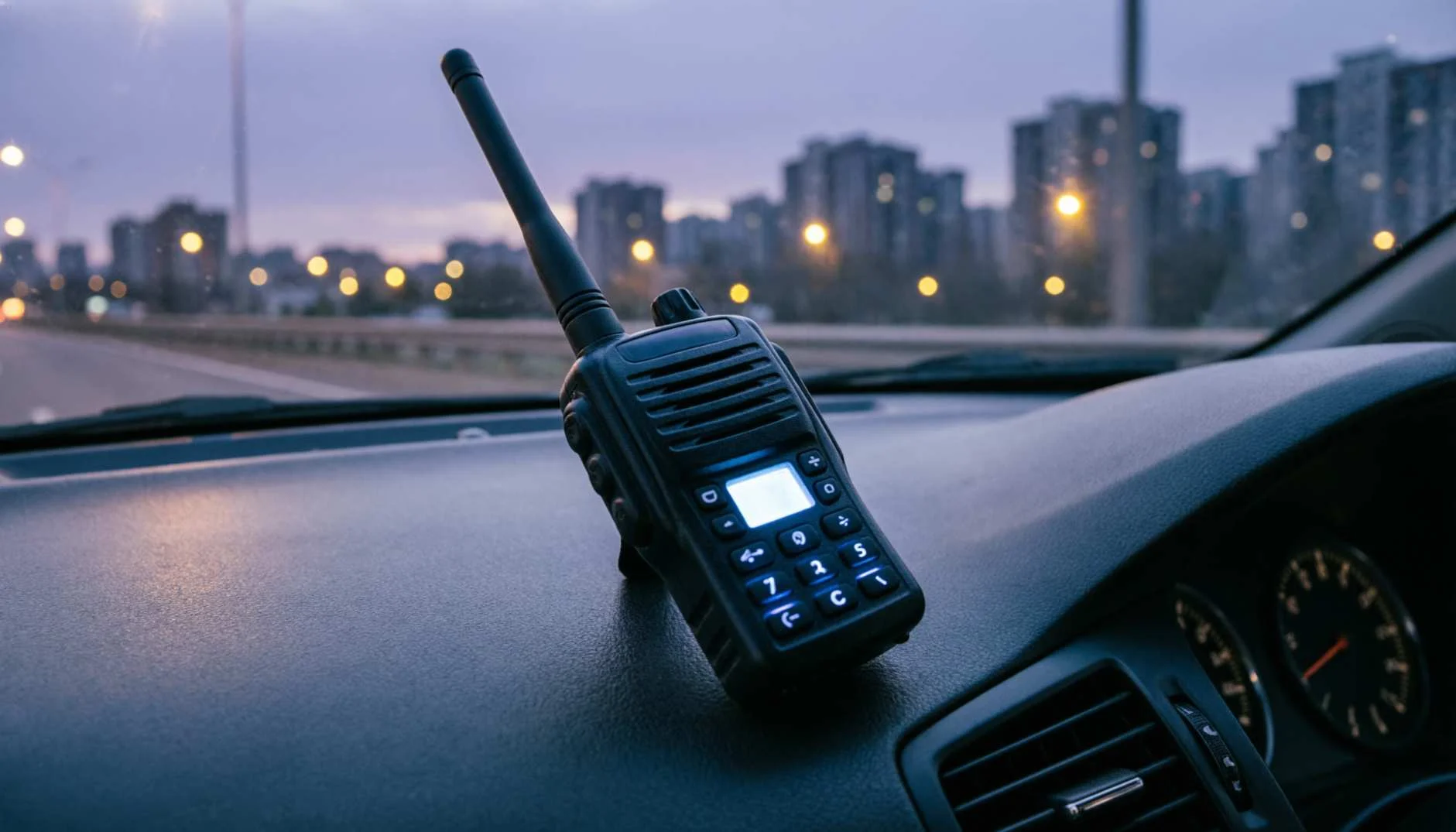
10-4 means “message received” or “understood.” It started as police radio shorthand in the 1930s and later spread through trucker CB radio culture, movies, and music until it became one of the most recognized phrases in American English.
Today people say “10-4” in radio calls, texts, and everyday conversation to confirm they got the message and agree with it. This guide explains where 10-4 came from, what it means in different settings, and how it connects to dozens of other radio and police codes people search for, from 10-33 to Code 4 and 1-Adam-12.
Quick Answer:
“10-4” is a radio brevity code meaning acknowledged, understood, or okay. Police departments in the United States began using it in the late 1930s to save airtime on crowded radio channels. Truckers picked it up through CB radio in the 1970s, and pop culture songs, movies, and TV shows turned it into a phrase almost everyone recognizes, even people who have never touched a radio.
What Does 10-4 Actually Mean?
“10-4” is a short way of saying “I received your message and I understand it.” It doesn’t mean “I agree” in a debate sense; it simply confirms the transmission came through clearly. A dispatcher tells an officer to head to an address, the officer replies “10-4,” and both sides know the instruction landed.
Outside of radio work, people now use 10-4 more loosely. Saying “10-4” in a text or in person usually just means “got it” or “sounds good.” It has drifted from strict radio jargon into everyday slang, similar to how “roger that” moved from military aviation into casual speech.
Where Did 10-4 Come From?
The system behind 10-4 traces back to the late 1930s, when the Association of Public-Safety Communications Officials (APCO) built a set of numbered signals for police radio. The APCO developed dozens of numbered shorthand signals in 1937 to speed up police radio communication when channel space was scarce. Early radios were unreliable at the very start of a transmission, so putting a number like “10” in front of the actual code gave the equipment a moment to catch up before the important part came through.
Illinois State Police communications director Charles Hopper widely developed the 10-code system in the 1930s. He designed it so every key message began with “10” followed by a second number, making messages easier to understand even through static.
The codes stayed inside police departments for decades until citizens band (CB) radio exploded among truckers and hobbyists in the 1970s. C. W. McCall’s 1975 song “Convoy,” which depicted trucker CB conversation, helped push phrases like “10-4” and “what’s your twenty” into everyday American English. Films and shows built around trucking and highway patrol culture kept the phrase in heavy rotation, and by the late 1970s “10-4” no longer needed any explanation.
One thing worth knowing: 10-codes were never standardized nationally. Different agencies assigned different meanings to the same number, which caused real confusion during multi-agency emergencies. Because of that, many U.S. police departments have shifted toward plain, spoken-out language instead of coded radio traffic for critical incidents. 10-4 is one of the few codes that survived that shift, mostly because it lives on in casual speech rather than official dispatch.
What Does 10/7 Mean for a Person?
10-7 means out of service. In police and dispatch use, it tells the radio room that a unit is not currently available to take calls; maybe the officer is at the end of a shift, on a break, or handling paperwork. In CB radio use, 10-7 similarly signals “out of service, leaving the air.”
When someone says “10-7” about a person casually, they usually mean that person is unavailable, off duty, or checked out for the moment; the same idea was borrowed from radio dispatch into everyday speech. It’s not an emergency code; it’s simply a status update.
What Does 10/5 Stand For?
10-5 means relay a message. It’s used when a unit can’t communicate directly with another unit or with dispatch and needs a third party to pass information along. For example, a dispatcher might ask one patrol car to “10-5” a message to another car that’s out of radio range.
In plain terms: 10-5 is the radio version of saying “please pass this along for me.”
What Does 10/6 Mean in Code?
10-6 means busy, stand by unless urgent. It tells the other party that the unit is currently occupied with something and can’t respond right away, but they should break in if the matter is truly urgent.
This is different from 10-7 (out of service). A unit that’s 10-6 is still working and reachable for emergencies; a unit that’s 10-7 is off the air entirely. People sometimes ask whether 10-6 means anything at all because it’s less commonly heard than 10-4 or 10-9. It does have a real, consistent meaning across most 10-code lists: “busy, please hold unless it’s an emergency.”
What Does 7 Adam 19 Mean?
“7 Adam 19” is a police radio call sign, not a message code. In departments like the LAPD, unit identifiers follow a pattern: division number – unit type letter – unit number.
- 7 identifies the police division or station the unit is assigned to.
- Adam is the phonetic alphabet for the letter “A,” and in LAPD radio tradition it marks a two-officer patrol unit (a one-officer car uses “Lincoln” instead).
- 19 is the specific unit or beat number within that division.
The first number identifies the police division or station, the letter identifies the type of unit, and the final number identifies the specific unit. So “7 Adam 19” simply means: a two-officer patrol car, assigned to Division 7, operating as unit 19. It’s an address for a specific car on the radio, not a status update like 10-4.
What Is a 10-9 Code?
10-9 means “repeat that” or “say again.” It’s used when a message wasn’t heard clearly, If from static, background noise, or a weak signal. In CB and police radio use, 10-9 is the standard request to repeat a message.
It’s one of the more universally consistent 10-codes, since almost every version of the 10-code list police, CB, and security keeps the same meaning for 10-9.
What Does 10-86 Mean?
This is a good example of why 10-codes confuse: 10-86 does not have one single meaning. It changes depending on the agency:
- In some police and CB lists, 10-86 means “officer/operator on duty.”
- In New York City Police Department radio signals, 10-86 refers to a female in or out of a vehicle, used with a timestamp.
- In some regional lists, 10-86 is used for a missing person.
Because of this inconsistency, if you hear “10-86” on a scanner, the safest approach is to check the specific department’s published code list rather than assume a universal meaning.
What Does 10-68 Mean?
Like 10-86, 10-68 varies by agency:
- Many general 10-code lists define 10-68 as “dispatch information,” essentially a request or notice involving information from dispatch.
- In New York City Police Department radio codes, 10-68 means “see complainant regarding” a specified issue.
The core idea across most versions is similar: 10-68 relates to sharing or requesting information tied to a call, even though the exact wording differs from department to department.
What Does a 10-33 Mean?
10-33 is one of the most consistent codes across different systems: it means emergency. Multiple radio code references list 10-33 as the code for a general emergency. When a unit calls “10-33,” it’s a signal that something serious is happening and other traffic on the channel should clear so the emergency message can get through.
Because it’s meant to interrupt normal radio traffic, 10-33 carries more weight than routine codes like 10-4 or 10-9. Hearing it usually means all available attention should shift to that transmission immediately.
What Does the Code 10-200 Mean?
10-200 isn’t a standard, widely recognized code the way 10-4 or 10-33 are. Most published 10-code lists stop well below 200, and where a “10-200” appears, it tends to be part of an extended, agency-specific, or informal list rather than a code with one accepted meaning nationwide.
If you’ve come across “10-200” in a specific document, app, or organization’s radio guide, it’s best to check that source directly, since it’s almost certainly a custom addition rather than part of the traditional APCO 10-code framework.
What Does 10-10 Mean (CB, Police, and Military)?
10-10 changes meaning depending on who’s using it, which makes it one of the more commonly misunderstood codes:
- Police use: In many police departments, 10-10 means “fight in progress, ” an active physical altercation that needs a response.
- CB radio use: Among truckers and CB hobbyists, “10-10” often means “transmission completed, standing by,” a way of saying “I’m done talking for now, but I’m still listening.” Some CB users also use it casually to mean “talk to you later.”
- Military and general public-safety use: There’s no single, official “military 10-code” the way there is for police APCO codes. Where you do see 10-10 in a military or paramilitary radio guide, it’s usually borrowed from the same civilian 10-code tradition and adapted locally, so its meaning depends entirely on that unit’s own radio procedures rather than a universal standard.
The takeaway: always match 10-10 to the specific system you’re hearing it in, since the same three characters carry different weight in a police scanner versus a trucker’s CB chatter.
What Does 10-11 Mean in Code?
10-11 also shifts by jurisdiction:
- Some departments use 10-11 for “animal problem.”
- Others use it to mean a unit’s office location or to request identification of the radio frequency in use.
- A few regional lists tie 10-11 to a traffic accident report.
Like several other codes on this list, 10-11 clearly shows why agencies never fully standardized the 10-code system nationwide. The same number can refer to an animal call in one town and a traffic report in another.
What Does 37 Mean in Security Guard Talk?
“37” is not a nationally standardized security code the way 10-4 is a nationally recognized police and CB code. Security companies, malls, and private facilities often build their own internal code lists, and “37” shows up in some of those lists to flag things like a suspicious person or an activity that needs a supervisor’s attention.
Because private security codes are set by each company rather than by any outside authority, there’s no single correct answer for what “37” means everywhere. If you’ve heard it used at a specific job or facility, the safest source is that employer’s own radio procedures or training manual.
What Is a Code 4 in LAPD?
Code 4 in the LAPD means “no further assistance needed.” Officers use Code 4 to tell dispatch and other units that the situation is under control and no additional help is required. The message lets nearby officers stand down, preventing backup units from continuing to a scene that’s already under control.
When an officer or dispatcher calls “Code 4,” they signal that the scene is stable and secure, with no immediate threat requiring additional assistance. Some agencies also use the related variant “Code 4 Adam” to indicate that no additional units are needed, even though officers haven’t caught the suspect yet.
Officers already at or near the scene continue handling the situation until they resolve it.
Code 4 is separate from the numeric 10-codes; the LAPD and several other departments use a smaller, single-digit “Code” system (Code 1 through roughly Code 30) for response priority and scene status, alongside the longer 10-code list.
Why Do They Say 1-Adam-12?
“1-Adam-12” became famous through the 1968 TV show Adam-12, which followed two LAPD officers patrolling in a car with that exact call sign. The name follows the same division-unit-number pattern explained earlier under “7 Adam 19”:
- 1 the police division the unit is assigned to (Central Division, in the show’s case).
- Adam phonetic for “A,” marking a two-officer patrol unit.
- 12 the specific unit or beat number.
The number “1” identified the division, “Adam” referred to a two-person patrol unit in the LAPD phonetic alphabet, and “12” identified the assigned beat area. The show adopted real LAPD radio procedures to create an authentic feel, and that realism explains why people still recognize “1-Adam-12” decades later, even if they’ve never seen the series.
What Does Code 7 Stand For?
Code 7 means out of service to eat, essentially a meal break. Police radio Code 7 means an officer is out of service to eat. When an officer calls in Code 7, dispatch knows not to assign new calls to that unit until the break ends and the officer reports back in service.
It’s a good example of how not every radio code involves danger or urgency; some, like Code 7, exist simply to keep track of who’s available to take a call at any given moment.
Quick-Reference Code Table
| Code | Common Meaning | System |
| 10-4 | Message rreceived/acknowledged | Police, CB, general |
| 10-5 | Relay message | Police, CB |
| 10-6 | Busy, stand by unless urgent | Police, CB |
| 10-7 | Out of service | Police, CB |
| 10-9 | Repeat / say again | Police, CB |
| 10-10 | Fight in progress (police) / transmission complete (CB) | Varies |
| 10-11 | Animal problem/location/traffic report | Varies by agency |
| 10-33 | Emergency | Police, CB |
| 10-68 | Dispatch information / see complainant | Varies by agency |
| 10-86 | On duty / female in-out of vehicle / missing person | Varies by agency |
| 10-200 | No standard national meaning | Agency-specific |
| Code 4 | No further assistance needed | LAPD and similar departments |
| Code 7 | Out of service to eat (meal break) | LAPD and similar departments |
This table reflects commonly cited meanings. Because 10-codes were never standardized nationwide, always confirm with a specific department’s guide when it matters, for example, when monitoring a scanner or working in public safety.
Common Mistakes People Make With 10-Codes
- Assuming one meaning fits everywhere. As shown with 10-86, 10-68, and 10-11, the same number can mean different things depending on the department or region.
- Mixing up 10-4 with agreement. 10-4 confirms a message was received and understood; it doesn’t necessarily mean the person agrees with what was said.
- Treating Code 4 and 10-4 as the same thing. They look similar but come from separate systems. Code 4 relates to scene status (“no further help needed”); 10-4 relates to message acknowledgment.
- Thinking all 10-codes are still used by police today. Many agencies have moved toward plain language for major incidents specifically because of the inconsistency between departments, even though a handful of codes like 10-4 and 10-33 remain common in everyday radio traffic.
FAQ
Is it correct to write “10-4” or “10/4”?
Both appear online, but the standard and historically accurate form is “10-4” with a hyphen, matching how APCO originally documented the codes.
Why do 10-codes always start with the number 10?
The “10” acted as a lead-in signal so older radios had a moment to fully engage before the important part of the message came through, reducing the chance the first word got cut off.
Do all police departments in the US use the same 10-codes?
No. There is no single national standard, which is why codes like 10-11 or 10-86 mean different things in different cities. Only a small handful of codes, especially 10-4, are consistent almost everywhere.
Can civilians legally use CB radio and say “10-4”?
Yes. CB radio is open to the public in the United States without a license requirement for most channels, and 10-4 is one of the most common phrases used on it.
What replaced 10-codes in many police departments?
Many agencies now favor plain, spoken language over coded radio traffic for serious incidents, so that any officer, dispatcher, or partner agency can understand the message immediately without needing to know a specific code list.
Is “roger that” the same as “10-4”?
They’re used the same way; both confirm a message was received. “Roger” comes from military and aviation radio alphabet traditions, while “10-4” comes from the police 10-code system.
Why does 10-4 still show up in text messages and casual talk?
Pop culture, especially 1970s trucking movies and music, spread “10-4” so widely that it became general slang for “okay” or “got it,” independent of any radio at all.
Does saying “10-4” mean the same thing in military communication?
Not officially. The military generally uses its own procedure words like “roger” and “copy” rather than the police-style 10-code system, though informal or joint-training contexts sometimes borrow “10-4” anyway.
What’s the difference between a 10-code and a Q-code?
10-codes are mainly associated with police and CB radio in North America, while Q-codes originated with early telegraph and ship-to-shore radio operators and are still used mostly in amateur and single-sideband radio.
Are 10-codes used outside the United States?
Some Canadian and a handful of other agencies adopted versions of 10-codes through the same CB radio culture that popularized them in the US, but usage and specific meanings vary by country and department.
Conclusion
10-4 means “message received and understood,” and its journey from a 1930s police radio fix to a phrase everyone recognizes says a lot about how professional jargon can become everyday language.
The wider world of 10-codes, from 10-33’s emergency alert to Code 4’s all-clear, shows a system built for speed and clarity, even if it was never fully standardized across every department.
When in doubt about a specific code like 10-86 or 10-68, the safest move is checking the exact agency’s own reference list, since the number itself only tells part of the story.

I am JohnsonMili, a passionate Prayer Writer and Spiritual Content Researcher dedicated to illuminating the paths of those seeking solace and inspiration.Through my platform, PrayersInfo.com, I share powerful prayers and uplifting faith content designed to foster a deeper connection with God.My mission is to guide readers toward peace and hope, empowering them to navigate life’s challenges with spiritual resilience.Join me on this transformative journey as we explore the profound impact of prayer and faith together.