Halal means “permissible” or “lawful” under Islamic law. It’s most commonly used to describe food, drinks, and actions that Muslims are allowed to consume or do according to the Quran and Islamic teachings. The opposite of allowed is haram, meaning “forbidden.”
This guide breaks down exactly what halal means in different languages and contexts, how halal food and meat are defined, how allowed differs from kosher, and how to spot halal products when you’re shopping or eating out.
Quick Answer:
Halal (حلال) is an Arabic word meaning “permissible” or “allowed” under Islamic law. It applies broadly to food, drinks, actions, and even financial dealings, though it’s most widely recognized in the context of food. Halal food excludes pork, alcohol, and meat from animals not slaughtered according to Islamic guidelines. The direct opposite is haram (“forbidden”). A related term, makruh, describes actions that are discouraged but not strictly banned. Halal certification confirms a product meets these religious standards.
What Does Halal Mean in Arabic?
In Arabic, halal (حلال) literally translates to “permissible” or “lawful.” It comes from the root word h-l-l, which relates to concepts of being untied, released, or made lawful.
Arabic speakers use halal far beyond food. A business deal, a relationship, or an action can all be described as halal if it aligns with Islamic principles. The word carries the same core meaning across the Arabic-speaking world, though everyday usage can vary slightly by region and dialect.
What Does Halal Mean in Urdu?
In Urdu, halal (حلال) keeps its original Arabic meaning: something that is religiously permitted. Urdu speakers, particularly in Pakistan and India, use it in daily conversation the same way English speakers might say “allowed” or “okay to do.”
You’ll commonly hear it paired with food, such as halal gosht (halal meat). Still, it also appears in discussions about earning money honestly, treating others fairly, or making lawful choices in everyday life.
What Does Halal Mean in Islam?
Within Islam, halal is one half of a broader ethical and legal framework found in Islamic jurisprudence (fiqh). Actions and objects generally fall into five categories:
| Category | Meaning |
| Halal | Permissible |
| Haram | Forbidden |
| Makruh | Discouraged, not sinful |
| Mustahab | Recommended, not required |
| Mubah | Neutral, no religious ruling either way |
Halal guidance comes primarily from the Quran and the Hadith (recorded sayings and practices of the Prophet Muhammad). Scholars across different schools of Islamic thought sometimes interpret specific details differently, which is why allowed standards can vary slightly between communities and countries.
What Does Halal Mean in English?
In everyday English, allowed is generally understood as “food or drink that is permitted for Muslims to consume.” It has become a mainstream term, appearing on restaurant signs, grocery store labels, and food delivery apps worldwide, even in countries with small Muslim populations.
English speakers who aren’t Muslim often first encounter the word through allowed food carts, halal-certified meat sections in supermarkets, or allowed restaurant menus, rather than through its full religious meaning.
What Does Halal Mean as Slang?
Outside religious contexts, especially on social media and among younger internet users, “halal” is sometimes used playfully to mean something is acceptable, wholesome, or approved of, while “haram” is used jokingly for something frowned upon or “cancelled.” For example, someone might caption a wholesome video “this is so allowed ” to mean it’s pure or good-natured.
This casual usage is informal internet slang and isn’t a religious ruling. It’s worth knowing the difference: the original religious meaning is precise and rule-based, while the slang usage is loose and situational.
What Is Halal Food?
Halal food refers to any food or beverage that meets Islamic dietary law. Broadly, this means:
- No pork or pork by-products (like gelatin from pork)
- No alcohol or intoxicating substances
- No blood or blood by-products
- Meat only from animals slaughtered according to Islamic method
- No meat from carnivorous animals, birds of prey, or animals that died before slaughter
Plant-based foods, grains, fruits, vegetables, dairy, and seafood (in most interpretations) are generally allowed by default, unless they’ve been processed with a non-allowed ingredient like alcohol-based flavoring or animal-derived gelatin.
What Is Halal Meat?
Allowed meat comes from animals slaughtered following a specific Islamic method called dhabihah or zabihah. This method requires:
- The animal must be a permitted species (such as cattle, sheep, goats, or poultry).
- The animal must be alive and healthy at the time of slaughter.
- A Muslim performs the slaughter, invoking the name of Allah.
- A sharp knife makes a swift cut to the throat, severing the windpipe, jugular veins, and food pipe.
- The blood is fully drained from the carcass.
This process is intended to be quick and to minimize the animal’s suffering, and Islamic teaching explicitly requires that animals be treated well before and during slaughter.
What Does Halal Mean in a Restaurant?
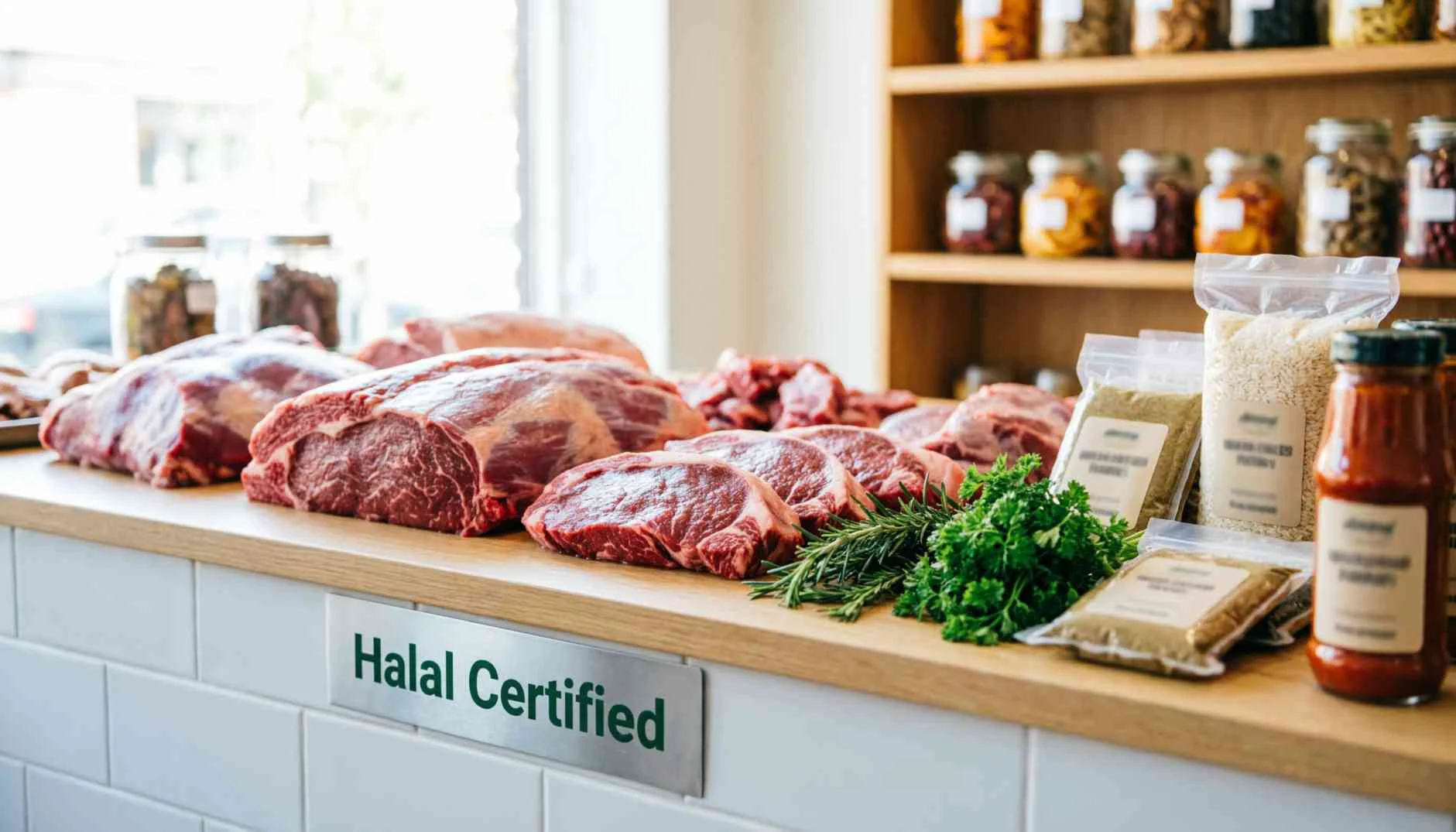
When a restaurant advertises itself as “halal” or displays a halal certification sign, it means the meat served has been sourced and prepared in accordance with Islamic dietary law, and the kitchen avoids pork, alcohol-based ingredients, and cross-contamination with non-halal items.
Genuinely halal-certified restaurants are typically audited by a recognized halal certification body. Some restaurants use the term loosely without formal certification, so diners who follow strict halal guidelines often look for an official certificate or logo rather than relying on signage alone.
Halal vs. Non-Halal Meat: What’s the Difference?
| Factor | Halal Meat | Non-Halal (Conventional) Meat |
| Slaughter method | Dhabihah (manual cut, blood drained) | Varies by country/facility, often mechanized |
| Blessing invoked | Yes, Allah’s name is said | No |
| Blood draining | Required | Not necessarily prioritized |
| Certification | Halal certification body | Standard food safety certification |
| Animal welfare requirement | Explicit religious guidelines | Governed by general animal welfare law |
Nutritionally, halal and non-halal meat from the same animal and cut are essentially identical. The difference lies in the method of slaughter and the religious compliance behind it, not in taste, safety, or nutrition, though some people report a preference in taste due to thorough blood draining.
How to Tell If Meat Is Halal
The most reliable way to confirm meat is halal is to look for certification from a recognized halal authority, which usually appears as a stamped logo on packaging or a certificate displayed in a restaurant or butcher shop. Ingredient labels can also help: watch for hidden non-halal additives like pork-derived gelatin, certain emulsifiers, or alcohol-based extracts.
When in doubt, asking the butcher, restaurant staff, or checking the brand’s official halal certification listing online is the safest approach.
Halal vs. Kosher: How Do They Compare?
Halal and kosher dietary laws share some similarities, since both come from Abrahamic religious traditions and both require a form of ritual slaughter, blood draining, and a ban on certain animals. However, there are meaningful differences:
- Kosher law forbids mixing meat and dairy; halal law does not have this restriction.
- Kosher slaughter is performed by a trained Jewish slaughterer (shochet); halal slaughter is performed by a Muslim.
- Alcohol is generally forbidden in halal diets but permitted in kosher diets.
- Some Islamic scholars consider properly slaughtered kosher meat acceptable under Islamic law, since Jews and Christians are recognized in the Quran as “People of the Book,” though views on this vary among scholars and communities.
Neither system is universally “stricter” across every category; each has areas where its rules are more detailed than the other.
Common Misconceptions About Halal
A few misunderstandings come up often:
- “Halal only refers to meat.” In reality, permissible applies to all food, drink, and even conduct, not just meat.
- “Halal certification means the food is healthier.” Halal status reflects religious compliance, not nutritional quality.
- “All permissible slaughter causes more animal suffering than conventional methods.” This is a genuinely debated topic. Islamic guidelines require a swift cut and prohibit cruelty, and studies on pain perception during slaughter vary and are not fully settled; animal welfare organizations and religious authorities have differing views, and some countries require pre-stunning even for permissible certification while others don’t.
- “Permissible and kosher are the same thing.” They’re similar but not identical, as outlined above.
FAQs
What makes something permissible?
Something becomes halal when it complies with Islamic law as outlined in the Quran and Hadith. For food, this generally means it’s free of pork, alcohol, and blood, and any meat included comes from an animal slaughtered using the proper Islamic method.
Are eggs permissible?
Yes, eggs are considered halal in virtually all interpretations of Islamic dietary law, since they come from a permitted source (poultry) and don’t require slaughter.
Is seafood permissible or haram?
Most Islamic schools of thought consider all seafood halal by default, since fish and other sea creatures don’t require ritual slaughter. Some stricter interpretations within certain schools limit this to fish specifically and exclude shellfish like crab or shrimp, so views can differ by community.
Can Muslims eat crab?
This depends on the school of Islamic jurisprudence a person follows. Many Muslims consider crab halal as a form of seafood, while some scholars within the Hanafi school consider only fish to be automatically halal and view other sea creatures like crab as questionable or haram.
Can non-Muslims eat permissible food?
Yes. Halal food has no restriction on who can eat it. Many non-Muslims choose halal food simply because it’s available, well-regulated, or because they prefer the preparation standards.
What are common examples of haram foods?
The most widely recognized haram foods are pork and pork by-products, alcohol, blood, and meat from animals that died of natural causes or weren’t slaughtered according to the Islamic method. Carnivorous animals and birds of prey are also generally considered haram.
Do Arab Christians use the word “permissible”?
Yes. Since halal is an Arabic word before it is a specifically Islamic one, Arabic-speaking Christians and other non-Muslim Arabic speakers also use it in everyday conversation to mean “permissible” or “allowed,” separate from its religious dietary meaning.
Why do some countries regulate or restrict permissible slaughter?
Several countries require pre-stunning of animals before slaughter as part of general animal welfare law, which affects how halal slaughter can legally be carried out there. This is typically framed as an animal welfare policy rather than a ban on halal food itself, and permissible-certified meat using pre-stunning methods is available in many of these places.
Key Takeaway
Halal simply means “permissible” under Islamic law, and while it’s best known through permissible food and permissible meat, the concept extends to everyday actions and conduct as well. Understanding the basic rules, the slaughter method behind halal meat, and how to verify certification gives you everything you need to navigate halal food confidently, whether you’re shopping, cooking, or eating out.

I am JohnsonMili, a passionate Prayer Writer and Spiritual Content Researcher dedicated to illuminating the paths of those seeking solace and inspiration. Through my platform, PrayersInfo.com, I share powerful prayers and uplifting faith content designed to foster a deeper connection with God. My mission is to guide readers toward peace and hope, empowering them to navigate life’s challenges with spiritual resilience. Join me on this transformative journey as we explore the profound impact of prayer and faith together.